Free SEO tool

Free SERP Preview Tool with AI Overview

Edit your title and description and watch the Google result update as you type, with every SERP feature that competes for the click.

Free · No signup · Six search locations

Edit your snippet

Fill in the fields below to update the live Google preview.

0/60 chars · 0/600px
Add a title tag.
0/160 chars · 0px
Add a meta description, or Google will write its own.
SERP features
AllImagesVideosNewsMapsMore
Example
example.com › page
Your title will appear here
Your meta description preview will appear here.
Sign in

It is an approximate preview. Google may rewrite titles or descriptions and show (or hide) dates, ratings, sitelinks and rich results.

Meta tags
<title></title>
<meta name="description" content="">
<meta property="og:title" content="">
<meta property="og:description" content="">
<meta property="og:url" content="">
<meta name="twitter:card" content="summary_large_image">

Everything this SERP preview tool does

The simulator renders your result the way Google renders it, at true width, with the same truncation rules. Type a title and description, or pull them from a live URL, and the snippet redraws as you work. Everything listed here is on the page above, with no signup and no upgrade prompt.

Live preview as you type

Every keystroke redraws the result. There is no preview button and nothing to refresh.

Desktop and mobile, at true width

One toggle switches between the two layouts, which truncate at different lengths. The desktop preview renders at Google’s full width instead of squeezing to fit the column, so the truncation you see is the truncation you get.

Fetch from URL

Paste any public page and the tool pulls in its current title and meta description, ready to edit against the live version.

Characters and pixels

Each field reports its character count and its rendered pixel width, with a fill meter and a plain hint. Google cuts on width rather than on character count, which is why a title inside the character limit can still be trimmed.

Keyword bolding

Add the keyword the page targets and the preview bolds the matches, the way Google bolds query words in a real result.

Save as an image

Export the preview as a picture, which is usually the fastest way to get a title approved by someone who does not read HTML.

Copy the meta tags

One copy button returns six finished tags: title, meta description, three Open Graph tags and the Twitter card type.

Copy the HTML

Returns a self-contained block that renders the result exactly as previewed, with the styles inline, so it survives being pasted into an email, a ticket or a client document.

Share a link

Every preview has its own URL. Send it and the person opening it sees the same snippet you are looking at.

See what sits above your result

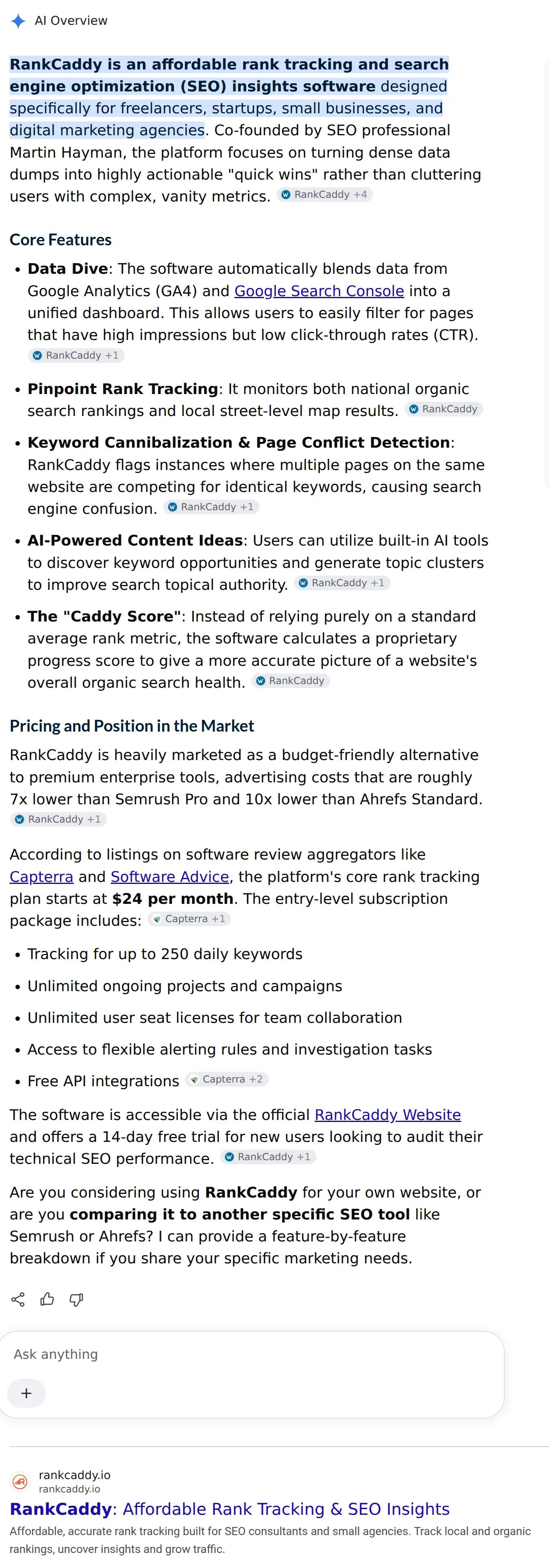
Ranking first stopped meaning appearing first. An AI Overview, a block of ads and a map pack can all sit between the top of the page and your snippet. Switch them on and the Google SERP preview pushes your result down exactly as they would, so you can see how far a searcher has to travel before they reach you.

Full-height capture. Scroll inside it to reach the snippet.

The SERP preview with an expanded AI Overview above the organic result

AI Overview, collapsed and expanded

Two separate toggles, because the two states take very different amounts of room. The collapsed overview leaves part of the first organic result in view. The expanded one usually does not. Switching between them is the quickest way to see how much of your position is worth on a query where Google answers first.

People also ask

The question block often lands between results rather than above them, which is why a snippet that reads well in isolation can arrive after four questions that already answered it.

Ads and the map pack

Commercial and local queries carry both. Turn them on for any keyword where you are competing for a transaction, and the top of the page fills before a single organic result appears.

Dates and review stars

A date makes a result look current and eats into the description. Review stars draw the eye and need product or review markup on the page to appear at all. Both change the shape of the snippet, so preview them before you decide the description length.

The click heatmap

An overlay showing where attention concentrates on a results page. It is a general pattern rather than your own data, and it is most useful for judging whether a lower position is worth fighting for.
Search the live SERP from six countries

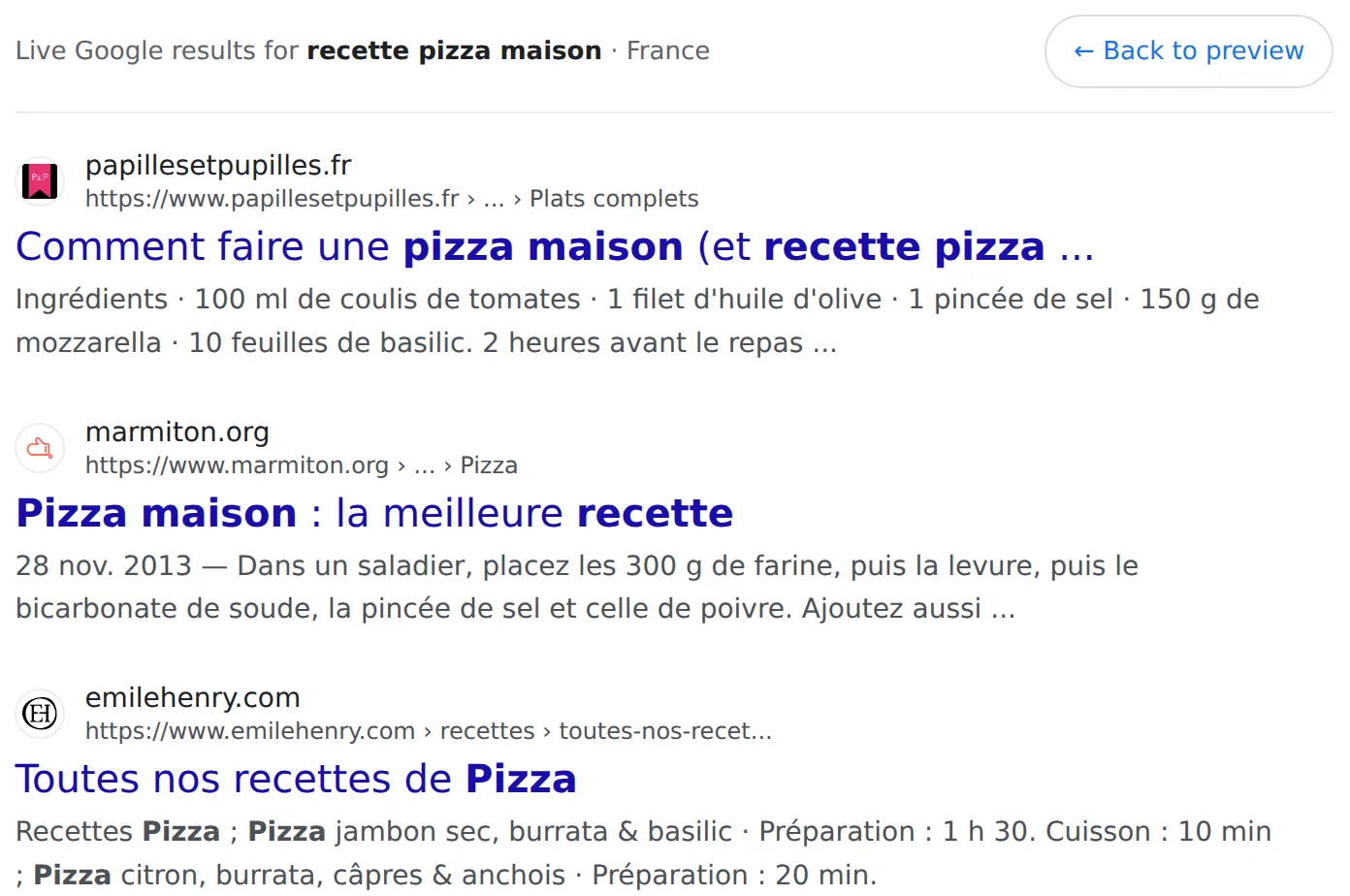
The preview shows your snippet. The search bar inside it shows everybody else’s. Type a query into the Google bar at the top of the preview, press search, and the tool returns the results Google is serving right now for the location you picked, in that country’s own language.

That matters most when the market is not yours. A Spanish or French SERP read in English is a different page to the one your customer sees, and translating your own title is not the same as looking at the competition they are choosing between. Switching the search location changes both the live results and the preview around them.

Live Google results for a query with France selected, shown in French

Search locations

  • United States
  • United Kingdom
  • Spain
  • France
  • Australia
  • India

Press back to preview and your snippet is exactly where you left it.

Writing a title and description that earn the click

The preview tells you what fits. These are the judgements it cannot make for you.

Title tag

Around 50 to 60 characters is the safe range, and the title tag preview above reports the pixel width alongside the count, which is the figure Google actually cuts on. A title of wide capitals can overrun at 55 characters while a narrow one survives at 62. Put the term the page targets near the front, where it survives truncation and where a scanning reader meets it first.

Meta description

Aim for 120 to 160 characters. It is not a ranking factor, but it is the only sentence you fully control on the results page, so give it one clear reason to click rather than a summary of the page. The meta description preview shows where the cut falls on mobile, which is earlier than most people expect.

Keyword in copy

Google bolds the words that match the query, in the title and in the description. Using the term naturally in both earns that bolding, and you can check how often it appears across the whole page with the keyword density checker.

URL

A short readable slug reads better in a result than a long parameter string, and Google renders it as a breadcrumb rather than as the raw path. If you are writing a fresh set of tags rather than editing existing ones, the meta tag generator builds them from scratch.

A snippet is one part of the page. To see the rest of it graded, check the whole URL.

What Google may change before it shows

The preview renders what you wrote. Google renders what it decides to show, and the two are not always the same. Knowing which parts are yours to control is what stops a rewritten title from looking like a mistake.

Rewritten titles

Google replaces titles it judges unhelpful for the query, often falling back to the H1 or to text near the top of the page. A title that is accurate, the right length and clearly about the query is the version most likely to survive.

Generated descriptions

Where your description does not answer the query, Google frequently builds its own from the page body. This is why a page ranking for several different queries can show several different descriptions.

The nosnippet controls

The nosnippet robots directive stops Google showing a text snippet for the page at all. The data-nosnippet attribute does the same for one element, which is the usual way to keep a price, a byline or a disclaimer out of the result. Both are blunt instruments and both reduce what a searcher sees before they click.

Everything else in the result

Dates, breadcrumbs, sitelinks and rich results are all query-dependent and device-dependent. The preview is a close approximation of the snippet, not a guarantee of the whole result.

How to preview your Google snippet

Four steps, and none of them need an account. The Google snippet preview updates as you go, so you can stop at any point and take what you have.

  1. 1

    Pick the search location

    Six countries, and it changes both the preview and the live results. Set it before you start writing rather than after.

  2. 2

    Paste the URL or write the tags

    Fetch from URL pulls in what the page currently has. Starting from scratch works just as well if the page is not live yet.

  3. 3

    Turn on the SERP features you expect

    AI Overview, ads, the map pack, People also ask. Match what the real SERP for your query actually shows, which you can check in the search bar above.

  4. 4

    Copy the tags out

    Take the six meta tags, save the preview as an image for approval, or share the link with whoever has to sign it off.

From one snippet to every ranking

A better snippet only pays off if the click rate moves, and that takes position data over time rather than one look at a preview. RankCaddy tracks Google organic and local rankings daily, blends your Analytics and Search Console data into one view, and shows which pages are quietly competing with each other.

Start your 14-day free trial

From $24 a month for 250 daily keywords, with unlimited projects and users on every plan. No card needed for the trial.

Frequently asked questions

What is a SERP snippet preview?

It shows how your page’s title, URL and meta description are likely to appear in a Google search result, so you can optimise them for length and click-through before you publish.

What is a SERP simulator?

A Google SERP simulator draws a mock results page around your snippet so you can see it in context rather than on its own. A SERP tool in the broader sense can mean anything that works with search results pages, including rank checkers, but a simulator specifically means one that renders the page for you. This one also lets you switch on the AI Overview, ads, the map pack and People also ask, so you can see what your result competes with.

How long should my title and meta description be?

Titles are safest at roughly 50 to 60 characters so they are not cut off. Meta descriptions work well at about 120 to 160 characters. Both fields report their pixel width as well as their character count, which matters because Google cuts on width, and the preview shows you where that cut falls on desktop and on mobile.

Why does Google sometimes show a different title or description?

Google may rewrite your title or generate its own description based on the search query and the page content. A well-written title and description of an appropriate length make it more likely Google uses yours.

Is this exactly how my page will look in Google?

It is a close approximation. Google also shows dates, sitelinks, breadcrumbs and rich results that vary by query and device, so treat the preview as guidance rather than a guarantee.

Do I have to type everything manually?

No. Paste a URL and use Fetch from URL to pull in the page’s current title and meta description, then edit them and watch the preview update live.

Are SERP checkers free to use?

This one is, with no signup and no credit card. That includes the live results search, the country selector, the AI Overview simulation and every export. Paid SERP tools generally charge for tracking positions over time rather than for previewing a snippet.

Can I see Google results for a different country?

Yes, for six of them: the United States, the United Kingdom, Spain, France, Australia and India. Type a query into the search bar inside the preview and the tool returns the live results for the location you selected, in that country’s language.

Which SERP preview tool should I use?

The tools on the first page of Google for this term all do the same core job, which is showing your title, description and URL as desktop and mobile results. Three things separate them. Whether the tool simulates the AI Overview and the other blocks that now sit above organic results. Whether it can show you the real search results for the query rather than only the mock-up. And whether it can do either of those for a country that is not your own. This one covers all three, across six countries. Run the same title through two or three of them and keep whichever matches the search results you actually work on.