TOPIC CLUSTERS
THE COMPLETE GUIDE
Topic clusters have been a major trend in SEO and as part of a content marketing strategy throughout recent years. As search engines place more emphasis on relevant and helpful content due to changing search behaviour, websites are implementing new ways of creating, publishing, and linking related pieces of content. A topic cluster content strategy is a fantastic way to provide genuine value to your users in a search-friendly way that allows them to dive deeper into a specific subject and builds site authority.
Using Topic Clusters with Rank Tracking
Using topic clusters with rank tracking is crucial because building a topic cluster is only half the job; the other half is knowing whether it’s working. This is where topic clusters and rank tracking meet. Instead of watching a handful of isolated keywords, you can group your entire cluster (pillar page plus every related article) inside a rank tracker like RankCaddy and monitor it as a whole.
Using a topic cluster strategy alongside rank tracking offers several key advantages that a single-keyword view cannot provide:
- Cluster-level performance, not just page-level. See at a glance whether the cluster overall is climbing, and which individual pages inside it are pulling the average up or down.
- Faster identification of cannibalisation. Topic clusters are, by design, several pages covering closely related ground, exactly the setup where two pages can end up quietly competing for the same keyword. RankCaddy’s conflict detection flags this automatically across a tagged cluster.
- Clear signal on when to expand vs. when to consolidate. If a cluster page is ranking well but a related page isn’t gaining traction, tracked data tells you whether it needs more internal links, a content refresh, or simply more time.
- Data Dive integration blends this ranking data with real Search Console and Analytics numbers, so you’re not just watching positions move, you’re seeing whether that movement is translating into clicks and traffic for the cluster.
Tag your topic cluster’s pages together in RankCaddy from day one, and the 6-8 week review step in the guide below becomes a five-minute check instead of a manual audit.
What is the Topic Cluster Model?
When asking, “What is the topic cluster model?” The answer is that, put simply, topic clusters are a way of creating, organizing, and linking content around a given theme or topic for improved search rankings.
Below is an example of traditional site architecture vs multi-topic cluster structure:
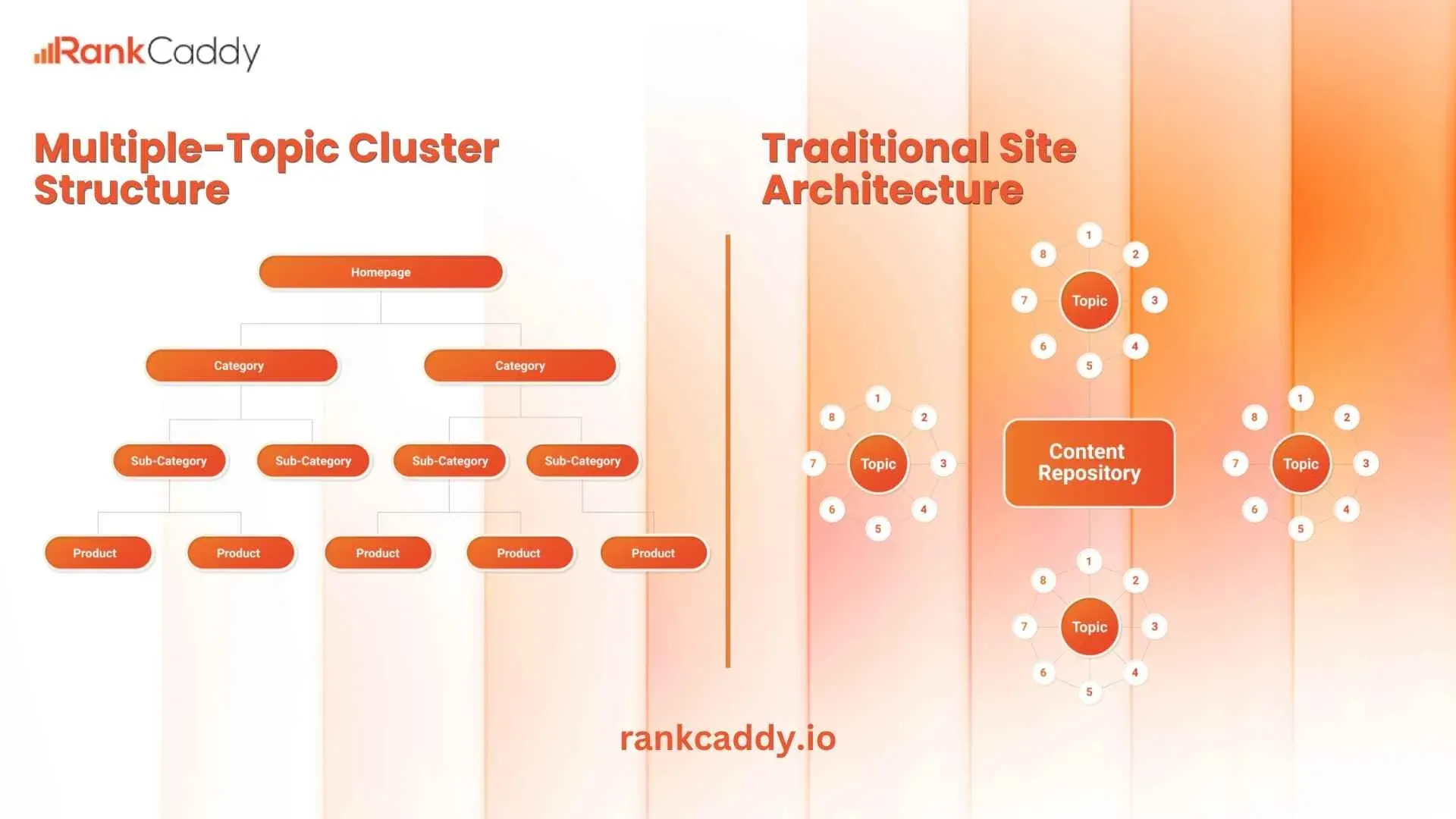
Each topic cluster has a main landing page with several related pages coming off it. Each is linked to the main hub page, but in many cases, they are also linked directly to each other, where appropriate.
The main landing page, also called a pillar page, contains your top-level information, targeted at short-tail, higher-volume, and competitive keywords that outline the core topic. The topic cluster pages are those that have more in-depth information about a given question or area, which is linked to from the pillar page.
It’s important that the pillar page broadly but succinctly covers the main information about a given subject, allowing you to logically link to the related content. Depending on the overall size of the topic, pillar pages can end up being quite comprehensive. There are two different approaches here, each with pros and cons. Some organisations choose to have a very long, very in-depth pillar page, potentially several thousand words. Others choose a more concise pillar page, with in-depth information published elsewhere.
Currently, there doesn’t seem to be any indication of what the best approach is. As is often the case, it matters much more that it works for your users than that it is what you should do according to others. On this page, we’ve taken the shorter option.
The Benefits of Using Topic Clusters for SEO
One of the benefits of using topic clusters for SEO is that by creating comprehensive, quality content around a given area, you give yourself the best chance of ranking on the search engine results pages for the widest range of potential search queries, even those low-volume but super-relevant long-tail keywords. Comprehensively covering a given topic is a fantastic, long-term way to grow your organic search traffic.
Adopting a topic cluster strategy will also help you build authority in the eyes of your customers around a given theme. This can be a fantastic way of building long-term brand loyalty and engagement from your existing customers, and attracting new ones.
Topic clusters are great for SEO as they group relevant pieces of content, with related keywords, together so both users and search engines can find them easily. A well-planned topic cluster has a range of content, tailored for your target audience, that matches their search intent. Also, by its very nature, a topic cluster strategy will naturally improve your internal linking.
The importance of pillar pages and content clusters for SEO strategies is clear, but it’s important to note that rather than focusing solely on certain keywords (although you will do that), your focus should be on the topic.
Step-by-Step Guide to Creating Topic Clusters
Following a step-by-step guide to creating topic clusters need not be difficult, but you’ll benefit from proper planning and research to create and organize the content in a way that is useful and logical.
Begin by thinking about what you’d like to achieve, and then work backwards to determine which areas of content creation you think will resonate. Depending on your niche, these may be fairly self-explanatory. For example, if you’re an installer of home renewable energy systems and you want to increase leads, consider the information your potential customers would likely need, and how you could best present this to them to encourage a conversion. Logical areas to create topic clusters about could include:
- Types of renewable energy systems
- Costs of purchasing and installation
- Long-term cost savings and ROI
- Environmental credentials
- Case studies
To make this easier, use RankCaddy to help generate content ideas and inform your keyword strategy. We use AI and combine it with your own data, and Google data such as PAA, to generate potential content titles and concepts for exploration.
Conduct your keyword research to find all the relevant terms you wish to target. Use a tool like RankCaddy to identify if certain keywords also display SERP features such as Featured Snippets, PAA, images, and videos. If they do, tailor your content to try and rank for these features.
From each of these you would publish further, detailed content to build out the cluster. Link back to the pillar page and any relevant, related cluster pages.
Once published, group the cluster’s pages together in RankCaddy so you can track them as a set from day one; this makes the review step below far faster.
After 6-8 weeks from publication, review the entire cluster. Are the pages receiving traffic? What are the engagement rates like? What keywords are the pages ranking for? Have you achieved any SERP features? Are there opportunities for adding internal links? Identify where you have and haven’t achieved your goals, and create a plan to update the content accordingly. Use RankCaddy’s Data Dive feature to take the hassle out of identifying quick wins and actions.
Continue to research and create content to grow the cluster. You may also find that as information changes, you need to update old content.
For more information, see our step-by-step guide to identifying cluster topics and creating topic clusters.
Examples of Successful Topic Clusters
There are many examples of successful topic clusters that organisations and brands have embraced and implemented within their content strategies across niches such as education, health, finance, and technology. Let’s explore some.
Podia: Website and community builder Podia created a fantastic topic cluster focused on creating and selling online courses.
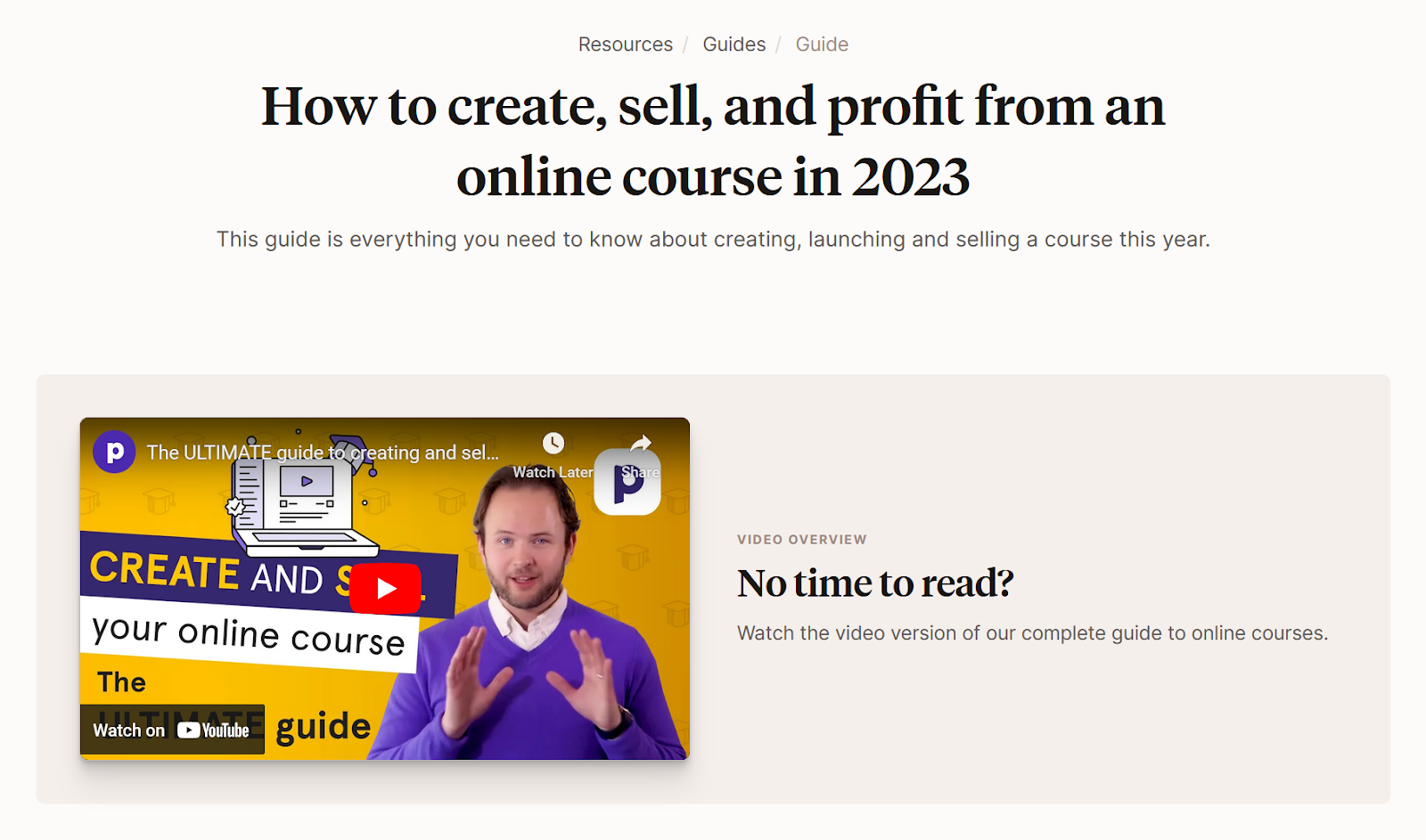
In this example, Podia teaches you everything you need to know about using their platform and effectively encourages the user to convert. They’ve opted for a shorter pillar page with clear in-page and side-nav links to other content. A nice touch is that they’ve also created a video version of this content to appeal to the widest user base.
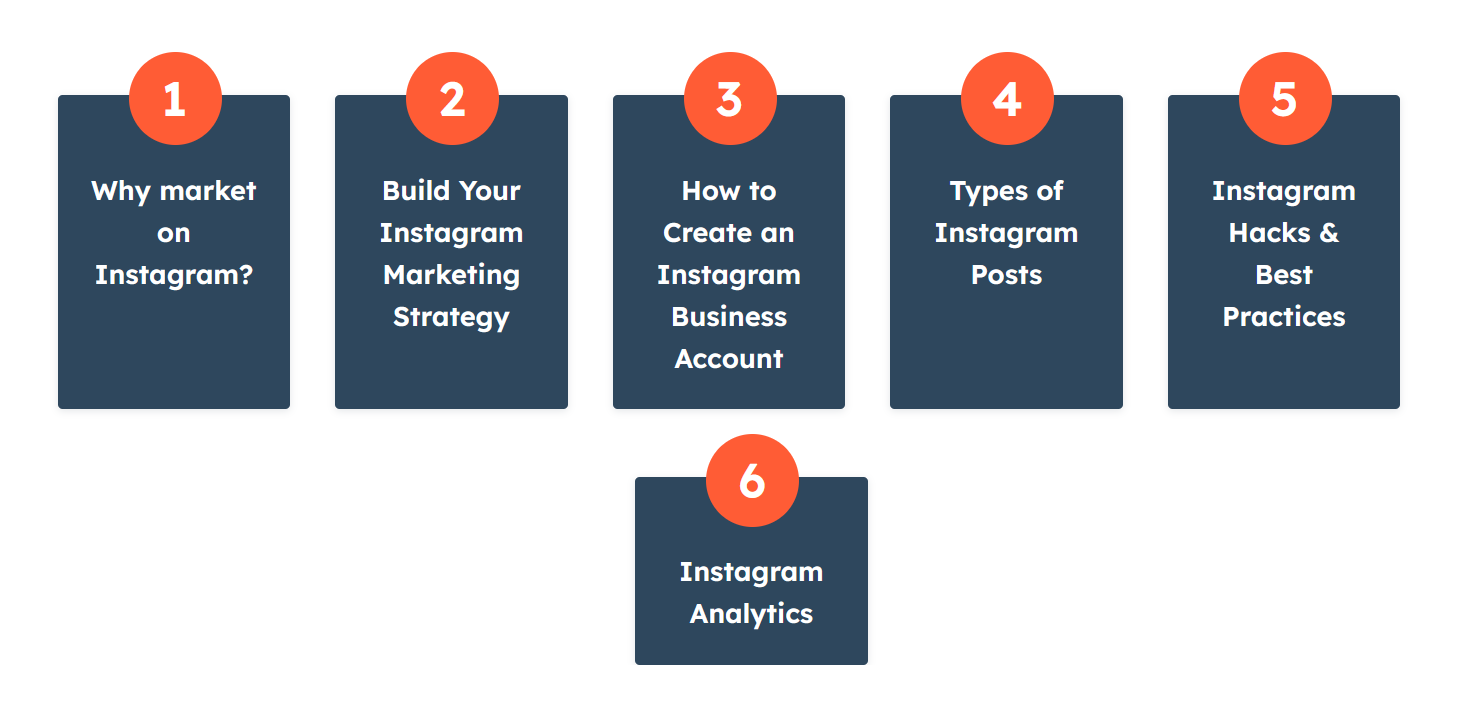
At the other end of the scale, HubSpot’s Instagram Marketing topic cluster is built around a pillar page that is incredibly well-researched and detailed.

Each section contains multiple links to related content, and due to the length, each contains its own video summary. What’s more, there’s a clear navigation at the top of the page to jump to relevant sections.
Wine Folly has created a fantastic topic cluster around the subject “What is Wine?” While it offers many of the other elements of pillar pages and topic clusters we’ve discussed, there’s one more thing: it looks great. It’s full of helpful images and graphics that break up the text and make it really digestible, yet it still gets across all the important information in a way that is easy to navigate.
Want to see more examples, including how to structure your own? Read our full breakdown in Examples of Successful Content Clusters in Different Sectors →
Frequently Asked Questions
What is a topic cluster?
A topic cluster is a group of interlinked web pages built around one central theme: a main “pillar” page covering the topic broadly, with several related pages going deeper into specific subtopics, all linked together. It’s a content and SEO structure, not a single page or article.
What is the topic cluster model?
The topic cluster model is an approach to organising website content around themes rather than isolated keywords. Instead of a flat site structure where pages exist independently, a pillar page sits at the centre of each topic and links out to, and receives links back from, a set of related cluster pages, signalling topical depth and relevance to search engines.
What is topic clustering?
Topic clustering is the process of grouping related keywords and content ideas together by theme before building out a topic cluster, typically done through keyword research to identify which subtopics and questions belong under a single pillar page.
How do you track whether a topic cluster is working?
Group the cluster’s pages together in a rank tracker (see “Using Topic Clusters with Rank Tracking” above) so you can monitor the cluster’s overall ranking trend, spot keyword cannibalisation between cluster pages early, and combine ranking data with real traffic numbers via Search Console integration.
More Information About Topic Clusters
For more reading, explore our in-depth guides to topic clusters below:
Ready to Track Your Topic Cluster’s Performance?
If you are ready to track your topic cluster’s performance, you’ll find that building the cluster is the hard part, but knowing whether it’s actually working shouldn’t be. RankCaddy lets you group your pillar and cluster pages together, track their rankings daily, spot cannibalisation between them automatically, and see the whole picture alongside real Search Console and Analytics data via Data Dive.